Gostrail is a project from Estonia, by Marcus Pertel and they create experimental, ambient drone music. The single “Obsidian Halls” was released in the beginning of March, and has been joined by the newest single “Winter Stasis” also dropping in March.
“Obsidian Halls” slowly grows in strength, vibrating and distorting, feeding upon itself as in takes form, filling the ancient halls with sonic vibrations, that can be felt in your chest. It is slow and consistent, the electronics working their way into every crevasse and fissure, while you can imagine the glassy surface of the obsidian pulsating and bending the reflected images. Is this going to be for everyone? Well, no is the simple answer, however for those that adore ambient drone, Gostrail will hit the sweet spot.
NourtierJulien (drum/sample) and EnaultAnthony (bass/sample) are TheShadow’sGoneOut, an industrial synth group from Tours, France. The single, “WhisperingGhost” came out on December the 1st, and the vocal samples are provided by Sandrine Grandjean-Samyn.
The grainy playback for the voice of Grandjean-Samyn, is the only human semblance of a human touch, in a track of wandering extremes, a tug of war between electronics and guitar, vying for dominance in order to gain your attention.
Grandjean-Samyn is the spectre within the music, seductively luring you into musical clutches of The Shadow’s Gone Out, as they envelop you with their experimental style of industrial music, pitching from delicate to heavy rock. Beware the “Whispering Ghost.”
Multi-instrumentalist Rev. BillySimmons, released back in June, his self titled debut album under the project name of EvidenceOfAStruggle, and this is the premiere of the sixth and last single, “Seize.” There is a revolving list of musicians that play with EvidenceOfAStruggle, creating the unique instrumental sound.
Photo by Jeremy Glickstein
Like some progressive, psychedelic lumbering monster, the track takes off. The guitars are what hit you the most, from those delivering the bass up to those that are plucked, keeping the pace and lightening the pensive mood against the ever building turgid backdrop.
Each of the singles has had a special animated video clip made by JohnAiro. There is a well of emotion just in one track, haunting in sound, where no words are needed. This is “Seize” by Evidence Of AStruggle.
Classical music is probably not something many think about, or they think that it is only the rock and roll life for them. However, it pervades our world, often taking us on adventures without our even knowing. Television shows, advertising, and importantly, movies often use classical music to sway our emotions. That is the power of this style of music. Secluded away in a Western Australian monastery, Father Robert Nixon, a Benedictine monk and a classically trained pianist, composes and plays his own pieces. Before joining the order, he hailed from the State of Queensland, played in goth bands, and was a concert artist of note.
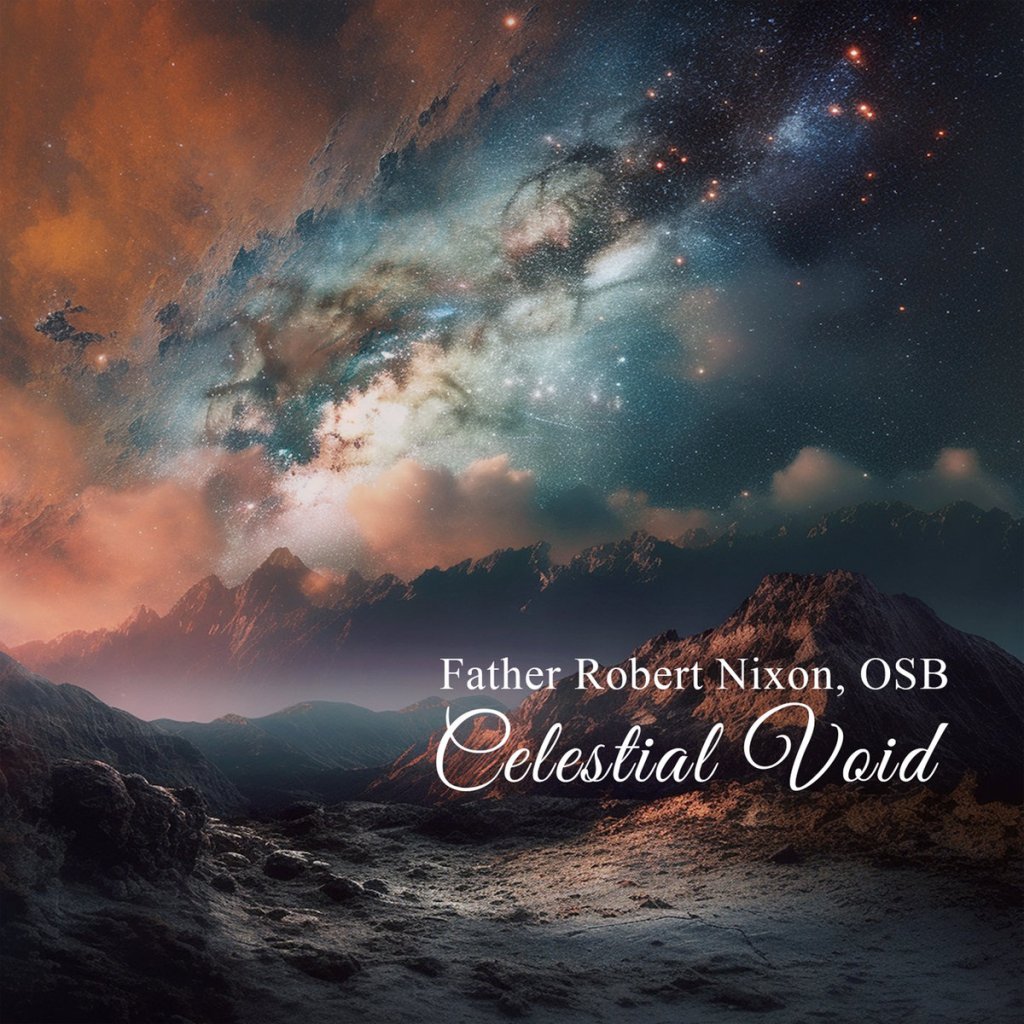
The album Celestial Void, on the US label, MoonCoil Media, was recorded at the monastery. A beautiful neo-classical platter of piano filled tracks is what you will find within, harkening back to the period of the German piano masters. Thoughtful, expressive, and full of longing that life brings, there is always a darker side and more bewitching with each listen. So, there really isn’t a more interesting person to talk to. I think, than Fr Robert as we delve into the music that he creates, what fuelled his passion for the craft, and what Celestial Void means to him. Ps…. oh my goodness, the man plays Baroque harpsichord….a deep abiding love of this style I have. Fingers crossed for that album maybe one day, but in the meantime, read on.
Welcome Father Robert into the hallowed halls of Onyx.
Many thanks! It is wonderful to be here and share with you and your readers, Adele.
You are a member of the Ordo Sancti Benedicti, also known as the Order of Saint Benedict. What drew you to join a monastic life?
Solitude and the interior side of life have always been important to me, and monastic life is directed towards the cultivation of that. Also, I love old buildings, ancient libraries, etc., which are things we have here in abundance! Of course, monastic life is based on faith, and I was raised a Catholic, so I have the Catholic faith and culture ‘in my blood’- my tastes incline very much towards the Medieval Catholic traditions, which are preserved in monastic life. We are really directed towards helping people on their own individual spiritual journeys and discovering their own path to truth and peace.
You live at the New Norcia Monastery, which is situated in Western Australia. Do you enjoy the solitude or with the age of modern technology, do you find yourself very connected to the world?
We are a little isolated from the world, and deliberately so- although visitors and guests are always welcome here. Of course, it is impossible to do very much at all without the aid of technology, so we stay connected, to some extent. But things like Instagram and Twitter, which probably a lot of people take for granted, are not a part of our life.
Before becoming a man of the cloth, you had previously mentioned to me that you came from Brisbane and were well acquainted with the term ‘swampy’, which is what goths in Queensland were called originally. How were you involved in the music scene back then?
Yes, indeed! I am not sure if that term is particular to Queensland, or even if it is still in use…In fact, I am from the northern part of Queensland (Townsville). Sure, I’ve been involved in music since the late 80’s, and so the music of Sisters of Mercy, The Cult, Bauhaus, and The Cure influenced me from a pretty young age, as did bands of other styles, like The Misfits, Danzig, and Bathory and all the interesting stuff that began to emerge in the late 80’s. This was all a source of inspiration, feeding into the classical music I was studying.
I started playing music (learning classical piano) when I was about 9, and then got my first professional performing job as a pianist in a French restaurant when I was 16.
The Benedictine monks are world renown for their involvement in music, with it being incorporated into prayer and mass, as well as widely circulated recordings of Gregorian Chants often written by the monks themselves. Is this something that drew you to the Order and obviously brings you a lot of joy?
I love traditional Gregorian chant (if it is well sung), and one of my roles here is directing music for liturgy. The harmonies and melodic formations in Gregorian chant are often very similar to those found in the darker genres of music. And playing our wonderful pipe organ brings me great joy!
Where did you learn to play piano? Are you self-taught, or were you classically trained?
I had lessons in the usual way, but (unlike most music students) I loved practicing because it was like a refuge for me and a way to create and to express myself. I studied composition and performance at university after I left school and travelled a bit to do more studies. I specialized in harpsichord, especially French baroque music, which is something I love, but don’t have much opportunity to do these days… I was active as a concert pianist for a while (and still am, in a way), and teacher of music in secondary and tertiary institutions. But then I felt called to seek a kind of higher truth through becoming a monk– but (luckily for me) music has continued to be the cornerstone of my life.
You signed to the label Moon Coil Media in the USA, which is run by William Zimmerman. I actually knew he was in negotiations with you because he was just so excited (but I was sworn to secrecy). What has this relationship and friendship meant for you?
William Zimmerman of Moon Coil Media is a fantastic guy, and very understanding of different genres and music. A lot of people had been asking me to put out a CD of my compositions, but I was keen to reach an audience beyond the usual boundaries of who would usually listen to my music, so I knew I had to work with a label that crossed boundaries.
We now come to the album “Celestial Void”. Most of the tracks are original compositions, apart from one Chopin piece. Do you find it easy writing instrumental pieces, or is it a bit of an arduous process at times?
I find a great joy in writing music, and feel that I am not actually ‘writing’ at all, but just channelling the music, which is perpetually flowing through the universe and through the heart. What I love about composing instrumental music is that you can express your feelings and thoughts completely, without spelling them out in words. This means you can say literally anything, even things you would never dare to say in words, so composing instrumental music is very liberating.
Each track seems to paint a vista of emotions, varying from quiet contemplation through to wistful sorrow. Do you feel that the classical form of music has this power to tune into the human psyche, more so than other forms?
Definitely. All forms and genres of music tap into something in the human heart, but possibly classical music can do that most profoundly and universally. I try to achieve an idiom which is not bound by time, and doesn’t immediately identify itself with a particular point in history, either the present or the past.
All of the album was recorded by you in the monastery. Did you find this difficult to accomplish as far as getting the right sound?
Yes, getting the right sound was an immense challenge! In the venue I most like to play in (our church, which is 175 years old), there is an unbelievably rich reverb. Playing live, this is fantastic, but when recording, it can make everything sound like a blur.
The album was mastered by Sean Beasley and the beautiful artwork created by Greg Rolfe. You must have been pretty pleased with how it all came together…..
Yes, Sean is a genius as far as the sound is concerned and was unbelievably diligent – he is a real perfectionist and an artist in sound! And Greg’s artwork is stunningly beautiful.
Do you have any tracks that you particularly love?
I like very much ‘Ode to a Nightingale.’ It’s inspired by the words of a famous poem by Keats. Just as a nightingale is expressing or channeling something complex, deep and beautiful through its song (although there are no words), so I am trying to do in this piece, and my other music.
The Chopin piece you chose is known to be technically difficult to play due to being in C#. Did you see this as a challenge?
To be honest, not really. Because I spent so many years practicing piano for about 4-8 hours a day, it wasn’t too much of a challenge technically. Paradoxically, I’m more comfortable playing difficult pieces than easy ones…
When I listen to the album, I hear the influences of the German piano masters such as Liszt, Richard Strauss, and, of course, Chopin. Have they been large influences on your style?
For sure. I am totally immersed in the idiom of Chopin and Liszt, from performing them so much, so that they almost seem like old friends to me. There is something timeless about the music and literature of the 19th century, and also something which seems to be deeply relevant to our own times.
Father Robert, you are well versed in Latin, so I am curious as to reasoning behind the tracks with Latin titles and do you find the Latin far more descriptive?
Somehow, the titles seems to work best in Latin, which is a beautiful and rich language. One single word in Latin can have several meaning and connotations, and it has a beautiful sonority.
For you, what are some of the themes covered by “Celestial Void”?
The album “Celestial Void” focuses on the theme of the longing for the transcendent or what lies beyond us. As a Catholic priest, I would tend to call this a “longing for God,” but it’s a human reality which is the experienced by people who don’t like to use that language or don’t believe in God. Anyway, this “Celestial Void” is a void because it surpasses all characteristics and limitations and names. Of course, other themes represented in the album are love, pain, and solitude, which are eternal and universal themes.
In your youth, what bands drew you to getting into music?
I listened to a wide variety of stuff, but mostly tending towards a dark aesthetic. So, I loved the melody, emotion, and elegance of bands like Sisters of Mercy, the Cure, Lacrimosa, etc. but also loved the imagination and musical skill of Kreator, Merciful Fate, and so forth. In the early 90’s there was a whole spread of new sonorities and approaches (with Emperor, Burzum, and similar artists just appearing), which was when I became acquainted also with the more experimental forms of classical music (through people like Stockhausen and Boulez), as well the work of minimalist composers like Philip Glass. As I become older, the music I compose and perform has become simpler and gentler.
Are there any modern bands you listen to now?
There are such a multitude of creative artists that it is almost impossible to name them. But I will definitely be paying close attention to what comes forth through Moon Coil Media!
If you were allowed to go anywhere in the world in order to record, i.e. basilica, studio, or auditorium, where would you go?
I would love to record at the monastery at Subiaco, in Italy. That’s were the founder of our order of monks, St. Benedict, first fled from the world to live as hermit in a cave. Today, there’s an ancient monastery there, set on the slopes of a steep mountain. It would be a place alive with mystical energy!
What is next for Father Robert Nixon OSB?
I’m keen to continue to use music to express myself, and contribute to the unfolding of the beauty of creation- not so much to use it to push my own Catholic faith, but to explore the spiritual and inner dimension of life, which are the true essence of the human condition. I’ve often thought about collaborating with a singer and lyric writer, so that’s something I’m hoping to do one day!
Thanks ever so much for taking the time to talk to us.
The debut album, Post Tenebras Lux, for Brisbane band, Balloons Kill Babies, is a point of great pride and yet there is a bitter sweet tinge, as it is also, currently, their last album for the foreseeable future. Bass player Karl O’Shea is no stranger to Onyx, being a member of Daylight Ghosts and Ghostwoods, plus it seems a hundred other bands (and have your noticed the fact all project names are related to death or after death??). ChristianCarter plays guitar and ScottDavey on drums, making up the trio. This instrumental album doesn’t just have value in the music, but also for the band members Carter and O’Shea, there have been years of life shattering challenges, such as addiction, and they are very open about their mental health which has influenced their music.
“This album means so much to me, after the treatment for Catatonia I was left suffering from Amnesia and regular Seizures, sometimes up to 7 a day with the worst lasting an hour. The remarkable thing was listening to the album again after the onset of amnesia, as if for the first time; and being able to pick up my guitar again and play the songs in their entirety. It was a massive part of my rehabilitation. The piano piece written by Karl and performed by his partner James Lees (Ghostwoods, Silver Sircus) “Flexibilitas Cerea”, we decided to name after one of the symptoms of Catatonia, “Waxy Flexibility”, where my limbs could be placed in various positions and I would stay in that position until someone moved me back.
Even though the album was written before the events of these illnesses, the title of the record rings truer than ever. It became the soundtrack to my recovery and rehabilitation from the worst period of my life. The project has simply run its course and I couldn’t think of a better record to go out on.” – Christian “Twiggy” Carter
A dream like air surrounds the first track “Creeper“, sinuous and gradually becoming foreboding in tone as the guitars start you on this journey. The track “L’appelDuVie“, drenched in beautiful guitar tones has the feelings of something lost and regrets that are a part of the past, swinging from gentle to manic.
Joined by on piano by JamesLees, from Ghostwoods, Lees puts in a haunting performance in piece “FlexibilitasCerea“, with a heaviness that sucks you under. The fervour of “MtCarmel” twists around you soul, flooding your ears with searing guitar that reaches out and “PostTenebrasLux” is truly a joyous piece that breaks out, trickling with gorgeous interludes. This is only a taste of what you can find on the album.
“Simply put, everyone behind the creation of this album has gone through significant changes over the last 5 years or so. Whether they be creative differences, a need to explore other projects or just simply wanting to move on, we’re all different people than we were at the beginning of all this. I think I speak for all of us when I say we’re fiercely proud of what we’ve managed to accomplish over the last decade plus and we couldn’t be happier with how the album turned out. It’s as perfect an ending as we could have asked for.” –Karl O’Shea
Davey is one busy guy on the drums and with O’Shea, they make a really tight rhythm section, while Carter just oozes sophistication on the guitar. The album has a huge sound to it, like if Tool was purely instrumental and they were creating rock inspired soundscapes, within someone’s brain. There is experimentation with noise which makes for a much more interesting experience. I am not surprised they are proud of this album. It is a great alternative rock release and if you appreciate well crafted music then you should really check out Post Tenebras Lux, because after the dark is light with BalloonsKillBabies. Cheers guys.
With the release of the debut album, The Egg That Never Opened, on the 17th of June, with the record label Art As Catharsis, you may or may not have heard of High CastleTeleorkestra, but I can promise you, that once you have, you are very unlikely to forget. A core of six members, dotted around the world, whom have been associated with some big name musical acts, plus the ability to draw on other talented musicians to further enhance their sound. What is this sound you might ask? Constructive insanity comes to mind but it is more than that. These guys are the musicians that other musicians tend to get really excited about with their alternative, progressive, instrumental mixtures of tasty perfection. Crazy good at what they do and while there is an assault of all these different genres, they craft it into tracks that are seamless, occasionally haunting and more often than not, a lot of fun. There is a pervasive feeling of joy from this band that goes into bringing each piece to life and it translate into the music. Tim Smolens and Chris Bogen are the originators of the band, so who else better to talk to about this juggernaut that they have brought to life and how important castles really are in the alternative rock scene.
We at Onyx go to extreme lengths to interview creative people but storming the battlements is a first for us, so we bid thee welcome to our nightmare of siege weapons, cool pointy things and comfy pillows. Well met on the interviewing battlefield, Tim Smolens and Chris Bogen of High Castle Teleorkestra.
Professed as both recovering professional musicians…. I find this statement misleading, as I am sure that neither of you have ever been able to give up the music drug. How did you get sucked into this life of moody tunes and can you tell us about your former shady lives, as Tim you were in Estradasphere and I.S.S. to name a couple of bands and Chris in the snotty named Doc Booger.
Chris: The HCT bio tells lies! I have never been a full-time pro musician though Tim has a few inhabitants in his brain and he could technically be considered as two recovering professional musicians. I’ve mostly done a lot of extremely low profile, community and friend oriented music projects that are usually left unfinished. I’ve been persistently doing home recording stuff since the mid 1990s with a few scattered live band situations. Doc Booger was my first “commercial” release and this is my third. Every band needs a luckiest member sort of hobbit character and I guess that’s my gimmick.
Tim: Lies indeed! Given the fact that we are such small beans in this giant burrito game, it is necessary for us to embellish a bit just to help us feel like we have something to contribute to this world of interesting music, especially at our ripe old ages. Truth be told, I am not sure I ever fully made a living from music but I can tell you that I have made 1000s of dollars from music in the last 30 years!
We gather you became domesticated, settled down, had jobs and even spawned?
Tim: Living the life of a broke musician throughout my 20s, I was certain that I never wanted kids. “Somehow” my wife became pregnant and I just embraced it. It turned out to be the best thing that could have happened to me, saving me from the sad lifestyle that so many contemporary musicians must endure. There probably hasn’t been a worse era to be a professional musician given that most people don’t buy music anymore. I would venture to guess that a majority of the public doesn’t care much for music at all other than in the most superficial of ways. So I have been married for 15 years now, have 2 kids, and make my living as an ER nurse. Even though it is hard to work music into that busy schedule, and I certainly test my wife’s patience with how much time put into it, I am under no pressure whatsoever to make a living from music although it would be a nice goal to strive for.
Chris: I was a semi-pro/amateur domesticated human for years which is probably why it took me so long to finally release some music commercially. I became professionally domesticated over a decade ago. Now there are three other people in the house that look just like me. My wife and kids are very supportive of the music project and aren’t at all sick of hearing me play the same parts over and over and over again to perfection. And yes, full-time jobs outside of music since 2004 in the Computer Science field. I have a Ph.D. in Comp. Sci. and it has afforded me a lot of great opportunities to do interesting work and live a balanced life. I am currently a full-time family dude, a full-time cyber security architect, a part time instructor, and a part time music dude. See. Balance!
Obviously, at some point you thought stuff this normalcy and had the idea to create some monstrous amalgamation of musical talent, calling it High Castle Teleorkestra. WHHHHHYYYYY?
Chris: I think we both hit a point in time when we were itching to create something big and prove something to the world. We knew it was time when some dramatic montage music played in the background of one of our thousands of Facebook chats.
Tim: The fact that Chris and I have stable jobs and families afforded us the luxury of having a man-cave project that our spouses would be in favor of, at least initially until they realized the depths of our obsession. During the pandemic it dawned on me how many super talented musicians I knew around the world and I didn’t see anything stopping me from forming a novel “band” with some of them.
Did covid influence this decision and maybe wanting a castle as well?
Tim: Covid was a good excuse and false pretense for making the band. A group of international talent forced to collaborate remotely due to restrictive lockdowns makes for a great narrative but the truth is we would likely be working this way regardless of the current situation on the global chessboard.
Chris: I’m going to be that annoying music snob guy that says that I’ve always wanted a castle even before everyone else wanted a castle. COVID had nothing to do with it though because we were already working together remotely having never met one another face to face.
Also, why a High Castle? Why not just a normal level Castle with a regular moat?
Chris: A high castle offers the best defense in depth strategy and you have a pretty damned good view. It’s like having a belt with suspenders. And who said we didn’t have a moat?!
Tim: It is good to have a lofty goal even if you only realize it partially. Plus with a higher castle you can see your enemy encroaching and give you ample time to prepare to fight or run for your life like a coward.
For those unfamiliar with the composition of the band, could you give us the lineup of the members and the associated acts?
Chris: Stian Carstensen is from Farmers Market and he is our resident virtuoso. Stian always raises the stakes on our songs and makes us want to quit trying to play musical instruments. Timba Harris is from Estradasphere, Duo Probosci, Ultraphuana, and a former Secret Chiefs 3 collaborator. Timba has a unique way of arranging and performing the perfect sort of provocative and rich string parts to our already dense tunes. Dave Murray (Estradasphere, Traun) is our resident metalhead and polyrhythmic guru, and he’s managed to get some amazing drum tones in his humble home studio setup. Bär McKinnon (Umlaut and Mr. Bungle) is one of the most unique songwriters around and is a songwriting gemstone of our band, and he also covers much of the woodwind work and vocals on his tunes. I play guitar and some other stuff sometimes (noise collages, synths) and do my imposter syndrome undistinguished member routine with expert precision. Tim (Estradasphere, ISS, former Secret Chiefs 3 collaborator) plays bass, piano, sings, is the chief producer, and he’s a pretty damned good cook (sorry, had to talk about food after so many words about music).
Tim: Yeah, what he said.
How the heck did you manage to gather this bunch into agreeing to being a part of this?
Tim: It is funny because when I first had this idea of forming a remote band and Chris and I set to work on a few songs, we had these guys on the roster in mind. We really took our time in asking them to officially join the “band” (courtship) because we wanted to have them play on some tunes first and be impressed and intrigued; sort of a proof of concept of the “business model.” We finally popped the question and they all said yes and we set out making more kids. This wedding night still goes on and on.
Chris: Tim and I prepared a demo of Klawpeels and Tim shopped it around to his well-established friends. I did my part by sitting back and pretending it was completely normal to be in a “band” with this roster of musicians.
A lot of these guys have been in some pretty bizarre projects, even you Tim playing live with Mr Bungle (all hail Chris Patton, Lord of the Bungle). Did you guys’ ever think…’what the fuck have I got myself into’ or was it like a comfortable set of shorts where the arse is not completely worn out yet?
Chris: I still don’t know what the hell I’m doing with these guys in HCT so I am just gonna stick with that Hobbit thing I said earlier.
Tim: To clarify, I have not played with Bungle. I did program a majority of their complex multi-keyboard setup for their California tour and they did open for my band Estradasphere as a secret warm up show for that tour. I have played live as the bassist for Bungle side project The Secret Chiefs 3. I have definitely soiled my shorts before but at this point they are pristine untl the upper thigh chub rub stench sets in.
As the name suggests, Teleorkestra, the music, is a mash of electronic and modern instruments mixed with traditional instruments plus also incorporating a vast array of styles…. sometimes all in the same track, which is bloody impressive. How did this all come about?
Chris: Our influences and interests are all over the map and combining them under one banner doesn’t seem so unusual to us. I think we just focused on each song and did our best to serve each one sonically. Somehow the track sequencing (which was sort of decided by chance) works as a satisfying progression of moods and sounds.
Tim: By the prefix “tele” is meant “at a distance” which is how our band conducts its activities.
Be honest, is it easier having your band mates as far away as possible and do you sometimes ignore their text messages and emails?
Chris: It probably makes it easier being apart because we would end up spending hours and hours together in person slaving over these mixes and parts. Tim and I did have a few days together in person like that midway through the project when I visited him in Colorado. I’m looking forward to some more days like that because there’s nothing quite like nerding out over some music you’re excited about with a good buddy. I never thought to ignore his messages though..
Tim: By keeping these egos at a distance we avoid the drama that close-quarters band activities inevitably brings forth. Although that was not the rationale for the genesis of our group it is a pleasant side-effect. In seriousness, bands usually do end up fostering interpersonal drama and our way of working remotely is a good way to filter a lot of that out.
Your debut album is “The Egg That Never Opened,” a title that implies the loss of something important or I could be completely wrong, and it is all about the Castle dragon. What inspired you to name the album after the epic first track (which is this quasi metal, confused French/German oompha band with a sea shanty singing barbershop quartet, on a Hawaiian holiday in space inspired piece)?
Chris: Dragons are cool though I did make one very angry once near Lonely Mountain. That’s another story though.
Tim: The album is indeed based on the Philp K. Dick Book “Radio free Albemuth.” The book is 30 chapters and we decided to take it linearly so it will be a trilogy and the 10 songs on this record represent the 1st 10 chapters. The phrase “The Egg That Never Opened,” is taken directly from chapter 1 and seems to imply a main character, Nick, whose life is in a rut, stagnating, with no obvious hope on the horizon for working his way out of it. But he has lots of positive qualities and interests that could have indeed led to a more colorful life; potential that was never realized.
Chris: Damn you, I was trying to be cagey and mysterious and you gave away the keys to the castle.
Is it true the album is an exploration of a Philip K Dick novel and have you recovered from this?
Tim: Yes, it is an adaptation of Philip K Dick’s discarded novel “Radio free albemuth,” which he ended up rewriting to become “Valis.” We have not yet recovered because we are still in the throes of it with the next two parts of the trilogy.
Chris: Yes and No.
Each track has a myriad of influences, that come together and just seem to work. With the members of the band being so far flung, how do you manage to write these grandiose pieces?
Chris: There’s typically a very strong vision for each song and a good template set forth before individual band members start tracking parts. There is some cross collaboration on the songs and arrangements early on though typically one member begins with a very firm idea and we work hard on firming up the foundational aspects of a demo – tempo map, mockups of essential parts, etc.
Tim: Most of the projects I have ever done have involved mixing and matching genres that usually are not found in the same song or even the same album. It is something I have gotten better at over the years and I feel is finally really clicking in a fluent way. You wouldn’t think that some of these mixtures would work well but on this record they feel natural and not contrived. European metal waltz. Romanian folk metal. Doo-Wop surf, and so on.
Technology now allows musicians to remotely record and share. Which member has the job of sewing it all together?
Chris: Tim does. And then me and the rest of the peanut gallery bust the seams and Tim has to do more sewing. I tend to eat a lot and not get enough exercise, so bursting seams comes naturally to me.
Tim: In general it is me that hosts the master files and I do the majority of editing and production but I am in daily contact with Chris on all the specific details. I am someone who loves teamwork and collaboration so having him to bounce ideas off is huge for me. I may be doing a majority of the grunt production work but his influence on this record cannot be overstated. Him and I rarely disagree and if we do it is in a friendly manner. The other guys will chime in if they have a suggestion. Bar is pretty specific related to the songs he wrote, so dialing that in on his 2 songs was a bit of a challenge to suit his fancy, but I think it all worked out really well.
“Mutual Hazard” was released as a single and it is a whirling dervish, magnetic and alluring, will probably drunkenly stab you later with a goose sort of thing. Who was the mastermind behind this track and what inspired you, as it is brilliant?
Chris: Dave Murray is the mastermind behind the metal aspects of the song which also contain the unorthodox polyrhythms. He arranged the guitar parts and I performed them with very slight modifications. Timba wrote and recorded the stunning string parts. As said, Tim was the mastermind of fitting all these disparate pieces together and making them work – with a little help from me and others in the peanut gallery. Most of the rest of it is in letting the performers and the melody shine.
Tim: I will add that the song is a traditional Romanian folk song and Stian is master of that style so he was very helpful and played some mean accordion parts as well as rhythm guitar (a nuanced rhythmic style that fall squarely outside of Chris’s wheelhouse). Stian brought in 2 guest players a Bulgarian violinist and a cimbalom player which really added to the authenticity of the folk aspect.
Interestingly, you are on the Art As Catharsis label, who are Australian, which leads us to ask why an Aussie label and how has that worked out for you?
Chris: We saw Crocodile Dundee and Young Einstein when we were kids and it inspired us to go buy boomerangs, big knives, and score an Australian label contract. When our music reaches the masses in Australia we are hoping to star in our own American-in-Australia wacky rom coms. I’m from Louisiana so I’ll be in Alligator Yankee. Who knows what Tim will do. But for real, we really dig Lachlan Dale (label manager) and his mission at Art as Catharsis. I’m proud to be a part of the AAC family.
Tim: Australia has been a great supporter of interesting music over the years. Mr. Bungle was very successful there and Estradasphere has many fans down under. It seemed like a natural fit to us. Art As Catharsis is a great label that has been a launching pad for many creative acts.
What bands and acts influenced your music insanity?
Chris: Chet Atkins, Arthur Lyman, Dick Dale, Martin Denny, Les Baxter, Esquivel, Perrey and Kingsley, The Three Suns, Luiz Bonfa’,Taraf de Haïdouks, The Shadows, Les Paul & Mary Ford, Santo and Johnny, Mr. Bungle, Secret Chiefs 3, The Ventures, Brian Eno, My Bloody Valentine, Harold Budd, Beach Boys, Slayer, Metallica, Death, Meshuggah, Steely Dan, Kraftwerk, Tangerine Dream, Mancini,and on and on.
Tim: to add to Chris’s nice list I would nominate Ennio Morricone and a variety of Italian film luminaries (Piero Picciono, Piero Umiliani, Bruno Nicolai, Nino Rota, and many more.), Joe Meek, The off kilter “world music” explorations of the label Sublime Frequencies, the harmonic mastery of Jacob Collier, Sam Cooke, a huge variety of Doo-Wop artists and so much more.
If you could have a guest musician or two, join you and it could be anyone, re-animated or living, whom would you dearly like?
Chris: If I had that kind of power then surely I could get more than one or two! Though there was one time where I had that wish while making the album: I would have really liked to have brought in Jean Jacques Perrey to do some crazy tape splicing stuff on the title track of our album. I would also have loved to have had Arthur Lyman play vibes on Placentia.
Tim: I would love to have Jacob Collier,whom Stian has collaborated with, guest on a track. I would bring back Joe Meek to produce surf songs for us, and a guest appearance from legendary studio drummer Bernard Purdie would be swell. (Chris: aw hell yeah!).
What is in the future for the eclectic High Castle Teleorkestra?
Chris: A short stack of filthy stinking $10 (USD) bills to divide amongst the band members so that we can take our families and significant others out to pick out their favorite pack of chewing gum or single serving hard candy piece!
Tim: We can hopefully finish off these next 2 albums to complete the trilogy before our bodies become infirm, we are wearing depends, ambulating with a walker, and falling frequently in our low-income nursing homes before we finally break that hip and the trials rehab prove to be the final blow. We will keep plugging away as quickly as our busy family lives will allow.
We thank you kindly for your parley, Tim and Chris, and we also know this album is going to knock some boots off!
Chris: Thank you, it was a gas!
Tim: Yes indeed, we loved this unorthodox interview.
Have you experienced High Castle Teleorkestra yet? If not then let me draw your attention to a good time. Signed to Art As Catharsis records, with members flung across the globe, who have been involved in many bands like Farmers Market, Mr Bungle and Estradasphere, and they are about to fling apon the world their new album, The Egg That NeverOpened, on June the 17th. So, to whet one’s appetite for the onslaught, here is their first video single, “Mutual Hazard“.
There are classical overtones that rapidly breakdown into a cacophony of metal fused with amazing traditional folk music and drumming that only enhances this brilliant piece. And if that is not enough, there is also the wonderful satire video, as it incorporates the televisual component of the band, while the music spirals in it’s dervish whirlings. High Castle Teleorkestra, utterly bonkers and loving it.
German composer and musician, AlexanderKling, just released his latest album, Love, which consists of nine song. You will find synth and piano lead music with soundscaping from his project, Dedalos.
This is the beginning and it starts with the “Ending“, a slow yet gradual building piece, with piano at the front and centre and synths giving depth. There is definitely the feeling of melancholy.
“Why” is a soundscape that taps into the MassiveAttack feels. A lonely expanse with whispered questions.
Third number is “Missing“. This is the loss of another or even a part of one’s self. A languid piece of realization that not all is right. There are musical outbursts along the way as the feeling builds. The buried vocals in the background lamenting ‘miss you so much‘.
Next is a bit of “Insanity“, a reflection of a mindset. The plodding rhythm of sadness settling into ones soul which then becomes the deafening noise that encapsulates all reason.
Darkness with bright areas is how I would describe “You“. There is such poignant bubbles of joy that slowly are eaten by the intruding dark fringes.
And so “Unbearable” follows. Low flowing and tidal with sound enveloping your senses. Nothing else but the feeling of being overwhelmed and that heartbeat rhythm.
“Last” is like the slow waking and a movement towards the dawn. It pauses for an effective break as the music builds. It is not joyous nor does it feel relieved but rather purpose driven.
The completion of any relationship is the “Farewell“. This is release with emotions still attached and yet within you hear the freedom to launch forward and leave the shackles of mental torment.
The conclusion is “Love“. Reflective and careful but with hope of the future, this is the title track and the end of a journey.
This is very much dark ambient/synthwave instrumental music which is very much based on real life. AlexanderKling explained to me how the album came about after the breakdown of a relationship.
ALEXANDER KLING
‘Istarted with this album after the end of a relationship. But I started to recording this album with the burning pain. Sometimes I cried while recording, it is tear notes. You can feel the atmosphere, you can feel the pain, the depression and sometimes salvation and peace’. – Dedalos
This is an instrumental journey through the heavy realization that not all loves last and that there is a beauty in that suffering, though painful non the less. This is despair, loss and revelation with Dedalos and his Love.




 Onyx Music Reviews