
Classical music is probably not something many think about, or they think that it is only the rock and roll life for them. However, it pervades our world, often taking us on adventures without our even knowing. Television shows, advertising, and importantly, movies often use classical music to sway our emotions. That is the power of this style of music. Secluded away in a Western Australian monastery, Father Robert Nixon, a Benedictine monk and a classically trained pianist, composes and plays his own pieces. Before joining the order, he hailed from the State of Queensland, played in goth bands, and was a concert artist of note.
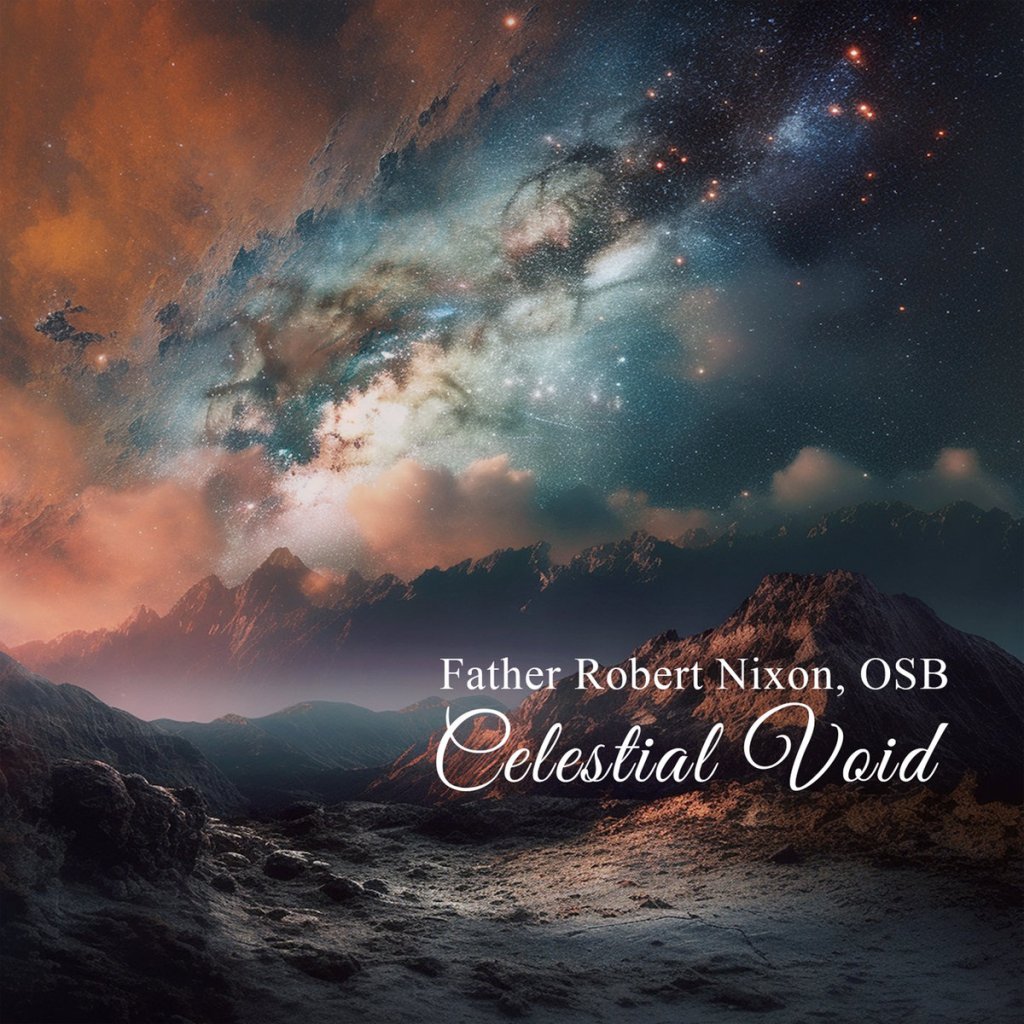
The album Celestial Void, on the US label, Moon Coil Media, was recorded at the monastery. A beautiful neo-classical platter of piano filled tracks is what you will find within, harkening back to the period of the German piano masters. Thoughtful, expressive, and full of longing that life brings, there is always a darker side and more bewitching with each listen. So, there really isn’t a more interesting person to talk to. I think, than Fr Robert as we delve into the music that he creates, what fuelled his passion for the craft, and what Celestial Void means to him. Ps…. oh my goodness, the man plays Baroque harpsichord….a deep abiding love of this style I have. Fingers crossed for that album maybe one day, but in the meantime, read on.
Welcome Father Robert into the hallowed halls of Onyx.
Many thanks! It is wonderful to be here and share with you and your readers, Adele.
You are a member of the Ordo Sancti Benedicti, also known as the Order of Saint Benedict. What drew you to join a monastic life?
Solitude and the interior side of life have always been important to me, and monastic life is directed towards the cultivation of that. Also, I love old buildings, ancient libraries, etc., which are things we have here in abundance! Of course, monastic life is based on faith, and I was raised a Catholic, so I have the Catholic faith and culture ‘in my blood’- my tastes incline very much towards the Medieval Catholic traditions, which are preserved in monastic life. We are really directed towards helping people on their own individual spiritual journeys and discovering their own path to truth and peace.
You live at the New Norcia Monastery, which is situated in Western Australia. Do you enjoy the solitude or with the age of modern technology, do you find yourself very connected to the world?
We are a little isolated from the world, and deliberately so- although visitors and guests are always welcome here. Of course, it is impossible to do very much at all without the aid of technology, so we stay connected, to some extent. But things like Instagram and Twitter, which probably a lot of people take for granted, are not a part of our life.
Before becoming a man of the cloth, you had previously mentioned to me that you came from Brisbane and were well acquainted with the term ‘swampy’, which is what goths in Queensland were called originally. How were you involved in the music scene back then?
Yes, indeed! I am not sure if that term is particular to Queensland, or even if it is still in use…In fact, I am from the northern part of Queensland (Townsville). Sure, I’ve been involved in music since the late 80’s, and so the music of Sisters of Mercy, The Cult, Bauhaus, and The Cure influenced me from a pretty young age, as did bands of other styles, like The Misfits, Danzig, and Bathory and all the interesting stuff that began to emerge in the late 80’s. This was all a source of inspiration, feeding into the classical music I was studying.
I started playing music (learning classical piano) when I was about 9, and then got my first professional performing job as a pianist in a French restaurant when I was 16.
The Benedictine monks are world renown for their involvement in music, with it being incorporated into prayer and mass, as well as widely circulated recordings of Gregorian Chants often written by the monks themselves. Is this something that drew you to the Order and obviously brings you a lot of joy?
I love traditional Gregorian chant (if it is well sung), and one of my roles here is directing music for liturgy. The harmonies and melodic formations in Gregorian chant are often very similar to those found in the darker genres of music. And playing our wonderful pipe organ brings me great joy!
Where did you learn to play piano? Are you self-taught, or were you classically trained?
I had lessons in the usual way, but (unlike most music students) I loved practicing because it was like a refuge for me and a way to create and to express myself. I studied composition and performance at university after I left school and travelled a bit to do more studies. I specialized in harpsichord, especially French baroque music, which is something I love, but don’t have much opportunity to do these days… I was active as a concert pianist for a while (and still am, in a way), and teacher of music in secondary and tertiary institutions. But then I felt called to seek a kind of higher truth through becoming a monk – but (luckily for me) music has continued to be the cornerstone of my life.
You signed to the label Moon Coil Media in the USA, which is run by William Zimmerman. I actually knew he was in negotiations with you because he was just so excited (but I was sworn to secrecy). What has this relationship and friendship meant for you?
William Zimmerman of Moon Coil Media is a fantastic guy, and very understanding of different genres and music. A lot of people had been asking me to put out a CD of my compositions, but I was keen to reach an audience beyond the usual boundaries of who would usually listen to my music, so I knew I had to work with a label that crossed boundaries.
We now come to the album “Celestial Void”. Most of the tracks are original compositions, apart from one Chopin piece. Do you find it easy writing instrumental pieces, or is it a bit of an arduous process at times?
I find a great joy in writing music, and feel that I am not actually ‘writing’ at all, but just channelling the music, which is perpetually flowing through the universe and through the heart. What I love about composing instrumental music is that you can express your feelings and thoughts completely, without spelling them out in words. This means you can say literally anything, even things you would never dare to say in words, so composing instrumental music is very liberating.
Each track seems to paint a vista of emotions, varying from quiet contemplation through to wistful sorrow. Do you feel that the classical form of music has this power to tune into the human psyche, more so than other forms?
Definitely. All forms and genres of music tap into something in the human heart, but possibly classical music can do that most profoundly and universally. I try to achieve an idiom which is not bound by time, and doesn’t immediately identify itself with a particular point in history, either the present or the past.
All of the album was recorded by you in the monastery. Did you find this difficult to accomplish as far as getting the right sound?
Yes, getting the right sound was an immense challenge! In the venue I most like to play in (our church, which is 175 years old), there is an unbelievably rich reverb. Playing live, this is fantastic, but when recording, it can make everything sound like a blur.
The album was mastered by Sean Beasley and the beautiful artwork created by Greg Rolfe. You must have been pretty pleased with how it all came together…..
Yes, Sean is a genius as far as the sound is concerned and was unbelievably diligent – he is a real perfectionist and an artist in sound! And Greg’s artwork is stunningly beautiful.
Do you have any tracks that you particularly love?
I like very much ‘Ode to a Nightingale.’ It’s inspired by the words of a famous poem by Keats. Just as a nightingale is expressing or channeling something complex, deep and beautiful through its song (although there are no words), so I am trying to do in this piece, and my other music.
The Chopin piece you chose is known to be technically difficult to play due to being in C#. Did you see this as a challenge?
To be honest, not really. Because I spent so many years practicing piano for about 4-8 hours a day, it wasn’t too much of a challenge technically. Paradoxically, I’m more comfortable playing difficult pieces than easy ones…
When I listen to the album, I hear the influences of the German piano masters such as Liszt, Richard Strauss, and, of course, Chopin. Have they been large influences on your style?
For sure. I am totally immersed in the idiom of Chopin and Liszt, from performing them so much, so that they almost seem like old friends to me. There is something timeless about the music and literature of the 19th century, and also something which seems to be deeply relevant to our own times.
Father Robert, you are well versed in Latin, so I am curious as to reasoning behind the tracks with Latin titles and do you find the Latin far more descriptive?
Somehow, the titles seems to work best in Latin, which is a beautiful and rich language. One single word in Latin can have several meaning and connotations, and it has a beautiful sonority.
For you, what are some of the themes covered by “Celestial Void”?
The album “Celestial Void” focuses on the theme of the longing for the transcendent or what lies beyond us. As a Catholic priest, I would tend to call this a “longing for God,” but it’s a human reality which is the experienced by people who don’t like to use that language or don’t believe in God. Anyway, this “Celestial Void” is a void because it surpasses all characteristics and limitations and names. Of course, other themes represented in the album are love, pain, and solitude, which are eternal and universal themes.
In your youth, what bands drew you to getting into music?
I listened to a wide variety of stuff, but mostly tending towards a dark aesthetic. So, I loved the melody, emotion, and elegance of bands like Sisters of Mercy, the Cure, Lacrimosa, etc. but also loved the imagination and musical skill of Kreator, Merciful Fate, and so forth. In the early 90’s there was a whole spread of new sonorities and approaches (with Emperor, Burzum, and similar artists just appearing), which was when I became acquainted also with the more experimental forms of classical music (through people like Stockhausen and Boulez), as well the work of minimalist composers like Philip Glass. As I become older, the music I compose and perform has become simpler and gentler.
Are there any modern bands you listen to now?
There are such a multitude of creative artists that it is almost impossible to name them. But I will definitely be paying close attention to what comes forth through Moon Coil Media!
If you were allowed to go anywhere in the world in order to record, i.e. basilica, studio, or auditorium, where would you go?
I would love to record at the monastery at Subiaco, in Italy. That’s were the founder of our order of monks, St. Benedict, first fled from the world to live as hermit in a cave. Today, there’s an ancient monastery there, set on the slopes of a steep mountain. It would be a place alive with mystical energy!
What is next for Father Robert Nixon OSB?
I’m keen to continue to use music to express myself, and contribute to the unfolding of the beauty of creation- not so much to use it to push my own Catholic faith, but to explore the spiritual and inner dimension of life, which are the true essence of the human condition. I’ve often thought about collaborating with a singer and lyric writer, so that’s something I’m hoping to do one day!
Thanks ever so much for taking the time to talk to us.
Thank you!
https://fatherrobertnixonosb.bandcamp.com/album/celestial-void?label=2702297979
https://www.facebook.com/MoonCoilMedia?mibextid=ZbWKwL
MoonCoil Media
 Onyx Music Reviews
Sounds great – real interesting. Thanks for posting.
LikeLiked by 1 person